Level crossings in France. Public actors and portfolio screening
This page maps the public safety apparatus around France's level crossings, the actors that carry it, the risk assessment layers it uses, and the portfolio question that arises beside it.
The reader gets:
- Who carries the infrastructure mandate.
- Which safety authority frames the scoring layer.
- Which method structures the field diagnostic.
- Which public reports and datasets make the asset base visible.
- Why a portfolio reading sits beside the five year diagnostic cycle.
- How the portfolio question becomes a screening layer at the end.
For infrastructure managers, funders and risk holders, the practical issue is how local safety diagnostics connect to programme level decisions across thousands of crossings.
1. Mapping France's level crossings
France's public rail perimeter is commonly described through two numbers, the national rail network that spans roughly 28,000 km [12, ↗] and the historic public inventory that counts 15,405 level crossings [8, ↗]. That figure narrows to 12,000 active level crossings, when filtering out private and non operational crossings [18, ↗].
For those crossings, five public actors share responsibility:
- SNCF Réseau who manages the rail infrastructure and reports to EPSF;
- EPSF who is the national railway safety authority and frames the rail side scoring method;
- CEREMA who provides the field diagnostic method for the five year safety obligation;
- BEA-TT who investigates major accidents and feeds back into public doctrine;
- Public authorities who finance suppression and upgrade projects at national, regional, departmental and municipal levels.
SNCF Réseau, public funders and territorial authorities work with constrained capital envelopes, safety expectations, cadence ambitions and political sensitivity around any decision to suppress, upgrade or defer. The difficulty is to know where a local diagnostic belongs inside a wider programme before detailed engineering starts.
2. Regulatory chronology
The current apparatus was built through a series of public responses across the last two decades. That sequence partly explains the shape of the French system, designed around public safety, field diagnostics, rail side scoring, national reporting and accident feedback.
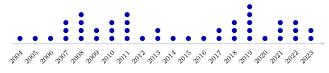
- On 2 June 2008, the Allinges collision with seven fatalities [22, ↗] led to the Plan Bussereau in 2009, which renewed the inscription nationale of the most preoccupant crossings and increased the suppression envelope.
- On 14 December 2017, the Millas collision with six fatalities [23, ↗] led to the Gayte mission [4, ↗], whose recommendations were retained in the Plan d'action pour la sécurité aux passages à niveau of May 2019 [3, ↗], including continuation of the Programme de Sécurisation National, deployment of the CEREMA five year diagnostic, and equipment of priority crossings with intelligent radars.
- On 24 December 2019, the Loi d'orientation des mobilités made the five year safety diagnostic mandatory for every level crossing [6, ↗].
- In March 2022, CEREMA published the diagnostic methodology [2, ↗].
- In November 2023, EPSF issued INF-GUID-021 V2 [1, ↗].

3. SNCF Réseau as the rail infrastructure manager
The French national rail network, the Réseau Ferré National, is managed by SNCF Réseau, and level crossings on the RFN sit within that infrastructure perimeter [12, ↗].
- Until 1997, infrastructure ownership and train operations sat inside SNCF.
- The law of 13 February 1997 created Réseau Ferré de France (RFF) as a separate public infrastructure manager [28, ↗].
- On 1 July 2015, following the rail reform law of 4 August 2014 [29, ↗], RFF merged with SNCF Infra and the Direction de la Circulation Ferroviaire to form SNCF Réseau in its current shape.
SNCF Réseau operates the Programme de Sécurisation National, launched in 1997, which targets crossings considered most concerning for suppression or safety upgrade [30, ↗]. Public reporting around the programme gives a partial view of the crossings identified as preoccupants, the annual investment envelope and the crossings under active suppression.
Two public data layers make the asset base visible.
- The SNCF open data inventory of level crossings provides the geolocated population of crossings with public or private classification and barrier or warning system information [18, ↗].
- The annual safety report series gives a recurring public view of incidents, investment, safety actions and programme progress [12, ↗] [13, ↗] [14, ↗].
For the infrastructure manager, the core operating frame runs through knowing the asset, diagnosing it, scoring it, reporting it, and suppressing or upgrading priority crossings over time.
4. Public risk assessment layers
French level crossing safety combines a railway safety authority and a technical diagnostic method. The public risk assessment landscape spans several layers, each answering a different question.
| Layer | Public status | Reading boundary |
|---|---|---|
| CEREMA field diagnostic | Mandatory five year cycle | Crossing and immediate approaches |
| EPSF INF-GUID-021 V2 | Published EPSF guidance | Rail safety perimeter |
| SNCF Réseau internal evaluation system | Internal operating layer | Infrastructure manager governance |
Each layer carries a distinct mandate.
- The CEREMA field diagnostic, mandatory under the LOM [31, ↗], observes signage, visibility, sight distance, road geometry, warning equipment and local operating conditions at the crossing and its immediate approaches, using the 2022 CEREMA methodology [2, ↗]. Completed diagnostics surface on the public cartography portal [20, ↗].
- EPSF, the national railway safety authority, publishes guidance, audits the infrastructure manager and receives SNCF Réseau's annual safety report. Its INF-GUID-021 V2 issued in November 2023 [1, ↗] scores each crossing from variables such as the road and rail traffic product, line speed and criticality adjustment, giving the rail safety workflow a common ranking basis.
- SNCF Réseau also manages its own internal evaluation system, closely related to EPSF's scoring logic, locating it as an infrastructure manager operating layer rather than a reusable public method.
Together, these layers define the public and technical landscape around the crossing itself.
5. Scope of the mandate, and beyond
5.1 The rail safety mandate
The crossing itself belongs to the rail safety mandate.
- SNCF Réseau carries the infrastructure perimeter.
- EPSF frames the safety scoring layer.
- CEREMA structures the field diagnostic method.
- BEA-TT contributes accident investigation and feedback.
5.2 The boundary of that mandate
But around that sits another set of public responsibilities.
- Emergency service geography involves health policy and civil protection.
- Local road dependence involves road authorities and municipal access.
- Land use and population exposure involve territorial planning.
- Climate stressors involve resilience planning.
- Public finance involves capital allocation across many places at once.
Once those responsibilities are spread across several actors, the next question is sequencing. Which crossings deserve earlier attention. Which territories carry adjacent exposure. Which projects justify field review before engineering resources are committed.
5.3 European readability
The same issue appears across Europe. Each infrastructure manager reports through its own institutional format, terminology and regulatory rhythm. A portfolio reader therefore needs a way to preserve national differences while keeping exposure comparable across markets [32, ↗] [33, ↗] [34, ↗] [35, ↗].
6. Why the portfolio question follows
The five year diagnostic cycle is the legal rhythm for each crossing's local safety diagnostic. The asset itself is long lived, yet the environment around it moves between two diagnostic cycles. Rail cadence changes how often trains use the crossing each day. Regional service intensification programmes such as France's SERM [36, ↗] accelerate that densification beyond historic perimeters. Road traffic, local development, emergency service geography, climate exposure, roadworks and detour patterns change the way that same crossing is used and depended on.
These indicators matter because they turn a rail object into a place where several public systems meet. A diagnostic remains the right instrument for the crossing itself. A portfolio reading gives the programme view that helps decide which places warrant attention before engineering budgets are committed.
Project cost gives the second reason to screen before design. Publicly reported suppression and upgrade envelopes show the order of magnitude.
- Agde PN288 involved an 18.5 M€ envelope split across the State, Département de l'Hérault, the CAHM agglomeration and the City of Agde [26, ↗].
- Saint-Médard-sur-Ille PN11 involved a 11.3 M€ envelope with the State, SNCF Réseau, Région Bretagne and Département d'Ille-et-Vilaine [25, ↗].
- Servon-sur-Vilaine PN179 involved a 9.2 M€ envelope cofinanced by SNCF Réseau, the State, Région Bretagne, Département d'Ille-et-Vilaine and the commune of Servon-sur-Vilaine [24, ↗].
At that magnitude, sequencing across many crossings becomes a public value question.
7. Where SAMRoute fits
The public safety apparatus remains the compliance base. SAMRoute enters after that base is understood. It serves the adjacent question of how to read the territory around thousands of crossings with the same definitions, the same geography and the same evidence trail.
Field diagnostics keep the local safety diagnostic auditable. Engineering studies keep project design specific. SAMRoute sits between them as a portfolio screening layer for the near environment of level crossings.
Owners know their assets. SAMRoute reads the territory around them. The same analytical pipeline runs against the active relevant population on the same reference, with hundreds of indicators per crossing today. Every per asset reading unfolds back to its foundational counts, distances and times.
The layer contributes three things.
- Around the perimeter, it reads exposure variables that sit beside the rail safety mandate, including emergency access for nearby populations, functional dependence around the crossing and population exposure.
- Between diagnostic cycles, it refreshes monthly as the primary rhythm, with weekly refresh on faster moving indicators.
- Across the active relevant population, it makes many crossings comparable through shared geography, repeatable indicators, stable definitions and traceable sources.
Infrastructure managers use that reference to focus field review and investment programmes.
Insurance and finance readers use it differently. For them, the active relevant population becomes an exposure base. Per-asset variables can feed frequency, severity and accumulation views, while BEA-TT investigations provide an accidentology reference over time.
That is the layer SAMRoute serves. Next to the local diagnostic. Before engineering design. Across the portfolio.
8. References
Regulation, methodology, and national policy
[1] EPSF. INF-GUID-021 V2 — Guide d'aide à l'évaluation du risque aux passages à niveau (EPSF, 2023). Read
[2] CEREMA. Diagnostic de sécurité des passages à niveau (CEREMA, 2022). Read
[3] Ministère de la Transition écologique. Plan d'action pour la sécurité aux passages à niveau (2019). Read
Parliamentary work
[4] Laurence Gayte. Propositions pour l'amélioration de la sécurisation des passages à niveau — rapport de la mission Gayte (Mission parlementaire confiée par le Premier ministre, 2019). Read
[5] Dany Wattebled. Proposition de loi n°407 visant à sécuriser les passages à niveau (Sénat, 2019). Read
[6] Didier Mandelli. Rapport n°368 sur le projet de loi d'orientation des mobilités — chapitre sécurité des passages à niveau (Sénat, 2019). Read
[7] Guy-Dominique Kennel. Question écrite n°01244 — Sécurité des passages à niveau (décret du 19 avril 2017) (Sénat, 2017). Read
[8] Patrick Hetzel. Question écrite n°21876 — Sécurité des passages à niveau (Assemblée Nationale, 2019). Read
[9] Bernard Perrut. Question écrite n°26603 — Plan d'actions pour la sécurisation des passages à niveau (Assemblée Nationale, 2021). Read
[10] Agnès Carel. Question écrite n°4346 — Sécurisation des passages à niveau (Assemblée Nationale, 2023). Read
[11] Fabien Genet. Question écrite n°01210 — Responsabilité des maires au sujet des passages à niveau (Sénat, 2024). Read
SNCF Réseau annual safety reports
[12] SNCF Réseau. Rapport annuel sécurité 2024 (SNCF Réseau, 2024). Read
[13] SNCF Réseau. Rapport annuel sécurité 2023 (SNCF Réseau, 2023). Read
[14] SNCF Réseau. Rapport annuel sécurité 2022 (SNCF Réseau, 2022). Read
[15] SNCF Réseau. Rapport annuel sécurité 2021 (SNCF Réseau, 2021). Read
[16] SNCF Réseau. Rapport annuel sécurité 2020 (SNCF Réseau, 2020). Read
[17] SNCF Réseau. Rapport annuel sécurité 2019 (SNCF Réseau, 2019). Read
Open data, tools, and press material
[18] SNCF Réseau. Liste des passages à niveau (SNCF Open Data). Open
[19] SNCF Réseau. Rapports sécurité (jeu de données) (SNCF Open Data). Open
[20] CEREMA. Cartographie des diagnostics de passages à niveau (CEREMA). Open
[21] SNCF Réseau. 12ème Journée Nationale de sécurité routière aux passages à niveau — Dossier de presse (SNCF Réseau, 2019). Read
Accident investigations
[22] BEA-TT. Rapport d'enquête technique — collision entre un TER et un autocar au PN 68 d'Allinges (Haute-Savoie, 2 juin 2008) (Bureau d'enquêtes sur les accidents de transport terrestre, 2009). Read
[23] BEA-TT. Rapport d'enquête technique — collision entre un TER et un autocar scolaire au PN 25 de Millas (Pyrénées-Orientales, 14 décembre 2017) (Bureau d'enquêtes sur les accidents de transport terrestre, 2020). Read
Local-government cofinancing
[24] SNCF Réseau / Préfecture de région Bretagne. Suppression du passage à niveau n°179 de Servon-sur-Vilaine — dossier de presse (2 février 2015). Read
[25] Conseil départemental d'Ille-et-Vilaine. Suppression du passage à niveau de Saint-Médard-sur-Ille (PN11) — annexe rapports (Conseil départemental d'Ille-et-Vilaine). Read
[26] SNCF Réseau. Suppression du passage à niveau n°288 d'Agde — dépliant 3 volets (SNCF Réseau). Read
Research
[27] IRT Railenium. MORIPAN — Bayesian network approach to level crossing risk assessment (HAL). Read
Foundational rail legislation
[28] République française. Loi n° 97-135 du 13 février 1997 portant création de l'établissement public Réseau Ferré de France (1997). Read
[29] République française. Loi n° 2014-872 du 4 août 2014 portant réforme ferroviaire (2014), entrée en vigueur 1er juillet 2015. Read
[30] Ministère de la Transition écologique. Passages à niveau — page politique publique (Ministère de la Transition écologique). Read
[31] République française. Loi n° 2019-1428 du 24 décembre 2019 d'orientation des mobilités (LOM, 2019). Read
European peer infrastructure managers
[32] ADIF. Declaración sobre la Red (Administrador de Infraestructuras Ferroviarias). Read
[33] Network Rail. Control Period 7 (CP7) Strategic Business Plans 2024-2029 (Network Rail). Read
[34] ProRail. Jaarverslag 2024 (ProRail, 2025). Read
[35] DB InfraGO AG. Geschäftsbericht 2024 (Deutsche Bahn, 2025). Read
National rail programmes
[36] Société des Grands Projets. Les Services express régionaux métropolitains (SGP). Read